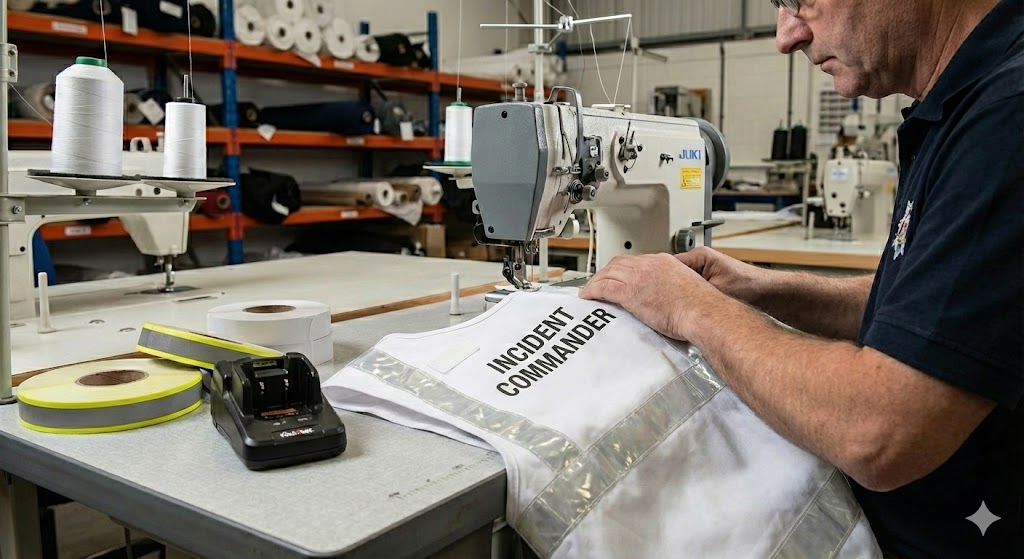


On the incident ground, unambiguous role identification is critical for safety and effective command. Our UK-manufactured fire service tabards ensure that Incident Commanders, Sector Commanders, and Safety Officers are instantly recognisable, supporting seamless coordination in line with National Operational Guidance (NOG) and JESIP standards.
Every tabard is made to order in our UK workshop, allowing for complete customisation of colours, chequered patterns, and role-specific wording. Engineered for the fireground, these bespoke solutions are designed with generous sizing to fit perfectly over structural firefighting PPE and tunics while meeting specific Brigade requirements.
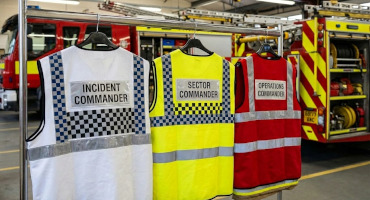
NOG Compliant Designs: Our primary command tabards feature the standard White, Yellow, and Red colourways required by National Operational Guidance. This ensures instant role recognition for Incident Commanders (IC) and Sector Commanders across cross-border deployments.
Role-Specific Badging: We manufacture made-to-order tabards with encapsulated reflective titles for specific roles, including Incident Commander, Sector Commander, Safety Officer, and Command Support.
UK Quality & Consistency: Manufactured in-house, we ensure that specific identifying colours and chequered patterns (Salmi) match the exact specifications required for UK Fire & Rescue Services.
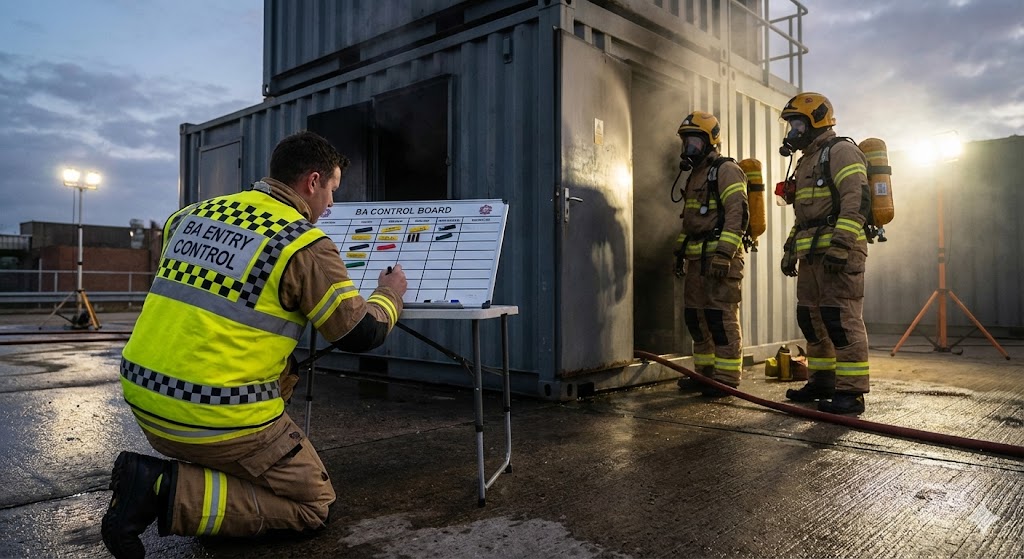
BA Entry Control: We manufacture dedicated tabards for Breathing Apparatus Entry Control Officers (BAECO). These are essential for rapid identification at bridgeheads and entry points.
Safety & Logistics: Beyond command, we supply distinct identification for Safety Officers and Command Support teams. This ensures clear lines of reporting and accountability on the fireground.
Specialist Hazard Roles: We produce specific high-visibility tabards for HazMat, Mass Decontamination, and DIM (Detection, Identification, Monitoring) teams, supporting complex chemical incident responses.
Sectorisation Clarity: Our range includes specific "Sector Commander" tabards. These allow Incident Commanders to clearly visual-manage large scale incidents by breaking them into manageable geographic or functional sectors.